
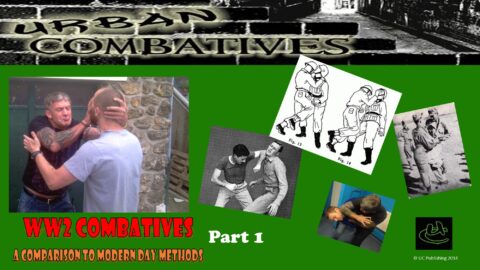
In this program we look at a comparison between the unarmed Combatives taught during the WW2 period compared to that of modern day Combative training.
Here We look at the kind of people that were learning for operational purposes and more importantly at some of the key figures that taught it during the war years.
For this we look to what was taught primarily in the UK and in the US. FROM THE British Commando /Auxiliary & s.o.e periods influenced by W.E. Fairbairn & E.A. Sykes.
To Dermot Pat O’Neil & John Jasper Styers of the US Army & US Marine Corp. WE also look AT THE Commonalties THAT Remain A CONSTANT TODAY FOR ANY WORTHY Combatives curriculum such as principle based methods, compressed curriculum and mentality driven emphasis.
Quite often the unarmed combat module of training constituted no more than 3 percent of the overall learning that some of these soldiers and operatives had to undertake, no more than a matter of hours, to learn something that could save your life or buy you time to get to a weapon before being sent to occupied territory where what you had learned ‘had to work’ or you wouldn't make it home!
This program is for historical study but also takes in to account the differing rules of engagement compared to today’s need for civilian self-protection and at what we have taken and continue to employ from the influence some of our close combat forefathers! enjoy UC 2014
Related Videos
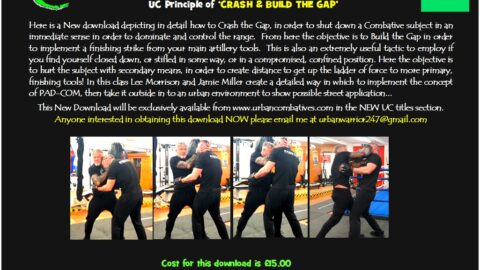

In this program we take our Combative Principles into a workable format on focus pads.
Knowing something or having a true understanding of how a principle works is only complete when you have a kinesthetic way to apply what you know. Here we employ such principles as; closest weapon/nearest target, high/low, cover-crash-counter, indexed-repeated strikes, flanking, branching, stop-hit, blitzkrieg and more with progressively applied pad training. Key points are given on feeding the pads, which is an art in itself as well as simple construction that will quickly take you into the realms of non-compliancy and spontaneity.
This program introduces UC Instructors Simon Grey and Tom Flint as well as 1st generation Instructor Jamie Miller.
This method of training with pads will totally accelerate your combative learning. Lots of key elements and fundamentals getting worked here; tool and impact development, bodyweight transference, understanding range, target-acquisition and transition , state access and management, perception speed, visual cue recognition and immediate spontaneous response.
Enjoy UC 2016
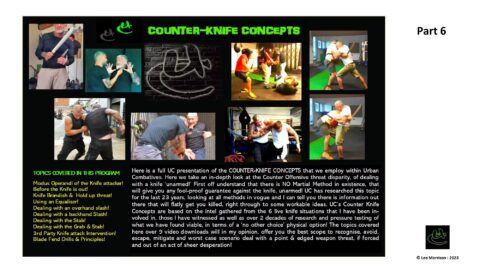
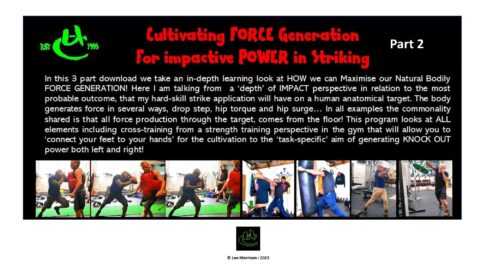

Due to the excellent feedback received from the previous three parts of this Combative Psychology series, I realised that there were still one or two areas that needed to be addressed in relation to the psychological aspects connected to aggressive and violent behaviour.
UC's foundation works from a basic core curriculum that focuses first and foremost on the two essential elements of Self Protection - namely: Personal Security or SOFT SKILLS, backed up with clinically efficient combative HARD SKILLS that take care of business in a physical sense if all else fails. This is the very foundation of UC - and indeed of any good reality-based method.
In addition to this, UC offers the student of Combatives two more follow-on programmes. One is COM-FIT, which focuses entirely on physical conditioning via cross-training to develop physical strength/fitness and attributes specific to combat. The second is PSY-COM, which relates specifically to mental conditioning and preparation so essential to TRUE combative functionality.
Without doubt, all fights begin and end in your head, and your personal pre-fight perspective is EVERYTHING! This programme is made up of an instructional lecture that comes directly from the PSY-COM programme. It deals specifically with cutting-edge ways of manipulating aggressive state in others, via non-physical options that are well proven for instantly reframing the classic "dick-head" perspective.
In addition to this, we follow on from part three with a previously unexplored part of the ARTIFICE module. Namely, cultivating the ability to pre-emptively strike from a natural and unobtrusive position with speed, impact, economy of motion and non-telegraphic intent - in order to either land the first strike that puts an end to the conflict, or in the worst-case scenario, a first strike that precedes an immediate, direct, explosive and continuous assault that won't stop until the threat subsides.
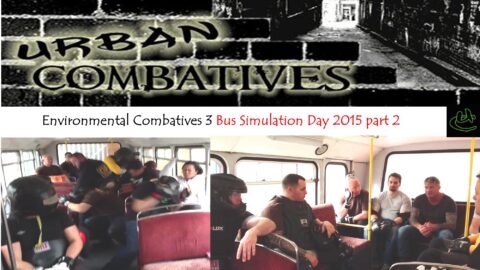
This 2 disc set depicts the best Instructional and Scenario scenes from our recent Environmental Scenario Training Day. This was the third of hopefully, five scenario days that we have planned, the next 2 being a train and a plane...
The two first were pub/bar environment then in-car scenario training and now the ‘bus’ commonality of all is confinement and restriction, going from close quarters to ECQ and back again.
Working from restriction requires a grasp of combative principles, the ability to branch skills and hit the mentality switch so necessary to the control of the emotional response associated with violence.
Here we got understanding and learning and a great pressure test of how well we know our tools! If you want to really know that what, you train so hard in, has merit and I mean REALLY? Then you’ve got to simulate! Period!
All of these works offer the Student/Instructor alike, with an example of how the scenario teaching template works. All Simulation Training requires competent design and supervision at all times, along with good KIT and a great bunch of people! This one had it all, Enjoy UC 2015….
There are no comments yet.