State Access

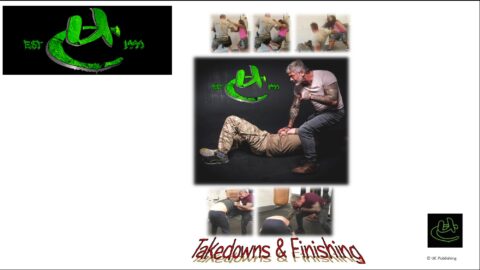
In part two of this Secondary Tools series we cover Combative Takedowns. Such methods are considered as secondary to the primary objective of pro-active impact via our pre-emptive strike, but with that said taking a Combative subject down to the ground fast is often employed as a transition from striking to putting the subject on the floor whilst controlling his descent to prevent injury.
Depending on the severity of the situation and rules of engagement, the objective might be to takedown and control a non-compliant individual on the ground as for a security operative or a police officer as a transition to hand-cuffing.
Or in more severe circumstances where the level of threat parallels the level force, we look at ways of employing environmental damage during a takedown via the use of a wall or a hard floor to maximise our Combative efficiency. Here we cover a variety of simple, dynamic takedowns all gross-motor in nature and tested under pressure like all good Combative tools. This DVD is a great addition to all previous UC programs and a must have addition to your Combative DVD library.
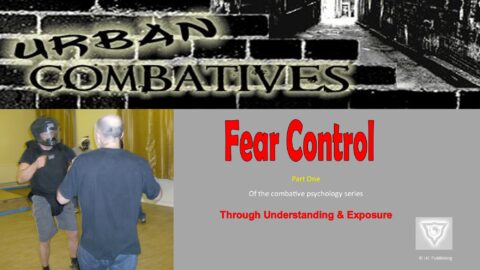
Outside of the more Combative or Reality based systems available, the most neglected aspect in the Martial Arts, Combative Sport and mainstream Self-defence relate to the mental aspect of any potentially violent confrontation.
The two main areas within this context relate to; Fear Control and the cultivation of a Combative Mentality or Mindset.
Part one of this two part UC Instructional lecture relates to the subject of Fear Control; or more importantly, understanding the difference between fear which is anticipation of an unknown outcome and the natural bio-chemistry of Adrenaline along with all of it's associated effects.
Knowledge dispels fear of the unknown and this instructional lecture will present proven methods designed to educate the viewer through knowledge and understanding of the adrenal response, which in turn will put you on the road to developing a strategy for management of the same. From understanding; must follow exposure, if any degree of desensitization is to be gained, here we look into ways in which he can employ
structured simulation and scenarios drills designed to illicit the adrenal response along with some of its associated effects on the mind and body.
Part one sets the scene for a further more in-depth look in part two, into access and control of some of our most intense emotions.
This 2-part series will benefit anyone interested in managing stress relating to violent confrontation.

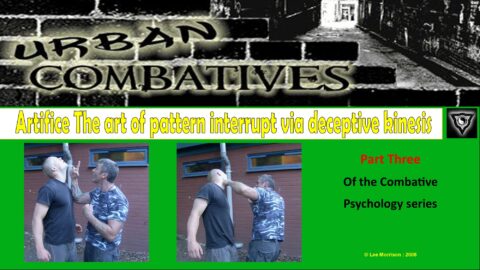
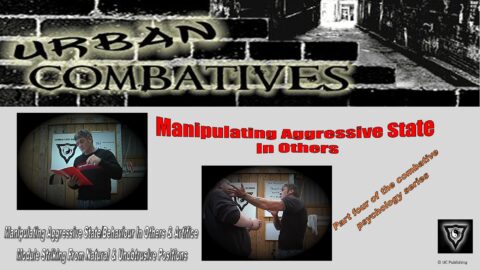
In this third and final part of this Combative Psychology series we look into the use of Deceptive Kinesis or Artifice.
The English Dictionary defines artifice as the use of deceptive trickery or misdirection.
This DVD looks at the employment of deception via behavioural manipulation and thought pattern interruption as a means to gain the upper hand in any potentially violent confrontation.
We look at deception from a two-fold approach, first from the perspective of a predatory criminal within the context of a potentially violent assault, via the use of distraction before assault and the use of classic ruses. The objective here is to gain an understanding of how deception might be employed against us in such a situation, so that we are less likely to be caught off-guard by it.
The second part of this two-fold approach looks at how we can use artifice as a precursor to pre-emption via the use of brain engagement, misdirection and pattern interruption.
We go onto look at means of developing congruence between body language, demeanour and verbalisation.
Along with ways of economising motion for the delivery of non-telegraphic impactive strikes.
The final part in this series acknowledges a well know Psychological aspect as a tool for the modern day warrior and makes a nice addition to what we covered in part one; Fear Control and part two; the Access and Management of Combative State.
Such methods of mental conditioning are an important addition to any physical conditioning and tool development program.
Related Videos
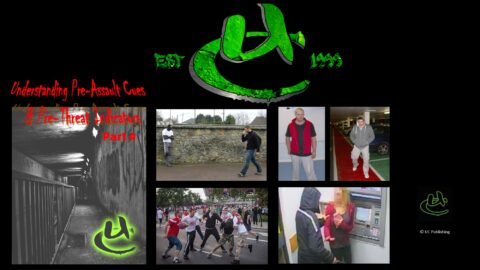
In This program we look at developing the skill-set of pre-threat cue recognition relating to both deceptive and aggressive pre-assault behaviour.
Learning to spot such things at the earliest opportunity, will in most cases allow you to avoid potential trouble in the first place which as we should all know, is the very essence of good self-protection.
Here we look at the pre-fight set ups of the common street predator from the employment of a deceptive ruse to the aggressive interview.
We look at the set ups employed by multiple assailants as well as how quickly knives can enter the equation via deceptive weapon access before deployment, if you have no idea of what to look for .
We look at our earliest options for dealing with such situations right through to our combative responses when there really is no alternative.
You owe it to yourself to enhance your soft skills and personal security by watching this program, it will make you more street smart!
Enjoy UC 2014
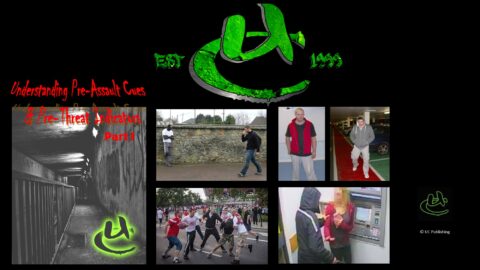
In This program we look at developing the skill-set of pre-threat cue recognition relating to both deceptive and aggressive pre-assault behaviour.
Learning to spot such things at the earliest opportunity, will in most cases allow you to avoid potential trouble in the first place which as we should all know, is the very essence of good self-protection.
Here we look at the pre-fight set ups of the common street predator from the employment of a deceptive ruse to the aggressive interview.
We look at the set ups employed by multiple assailants as well as how quickly knives can enter the equation via deceptive weapon access before deployment, if you have no idea of what to look for .
We look at our earliest options for dealing with such situations right through to our combative responses when there really is no alternative.
You owe it to yourself to enhance your soft skills and personal security by watching this program, it will make you more street smart!
Enjoy UC 2014
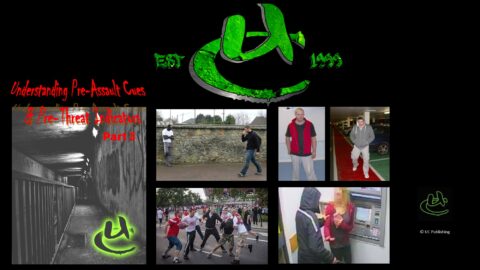
In This program we look at developing the skill-set of pre-threat cue recognition relating to both deceptive and aggressive pre-assault behaviour.
Learning to spot such things at the earliest opportunity, will in most cases allow you to avoid potential trouble in the first place which as we should all know, is the very essence of good self-protection.
Here we look at the pre-fight set ups of the common street predator from the employment of a deceptive ruse to the aggressive interview.
We look at the set ups employed by multiple assailants as well as how quickly knives can enter the equation via deceptive weapon access before deployment, if you have no idea of what to look for .
We look at our earliest options for dealing with such situations right through to our combative responses when there really is no alternative.
You owe it to yourself to enhance your soft skills and personal security by watching this program, it will make you more street smart!
Enjoy UC 2014
Outside of the more Combative or Reality based systems available, the most neglected aspect in the Martial Arts, Combative Sport and mainstream Self-defence relate to the mental aspect of any potentially violent confrontation.
The two main areas within this context relate to; Fear Control and the cultivation of a Combative Mentality or Mindset.
Part one of this two part UC Instructional lecture relates to the subject of Fear Control; or more importantly, understanding the difference between fear which is anticipation of an unknown outcome and the natural bio-chemistry of Adrenaline along with all of it's associated effects.
Knowledge dispels fear of the unknown and this instructional lecture will present proven methods designed to educate the viewer through knowledge and understanding of the adrenal response, which in turn will put you on the road to developing a strategy for management of the same. From understanding; must follow exposure, if any degree of desensitization is to be gained, here we look into ways in which he can employ
structured simulation and scenarios drills designed to illicit the adrenal response along with some of its associated effects on the mind and body.
Part one sets the scene for a further more in-depth look in part two, into access and control of some of our most intense emotions.
This 2-part series will benefit anyone interested in managing stress relating to violent confrontation.
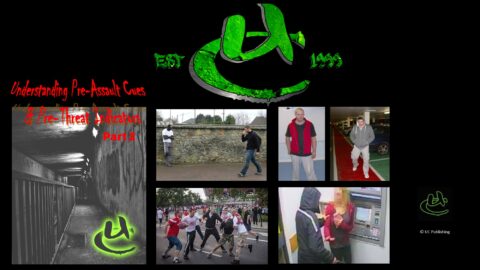
In This program we look at developing the skill-set of pre-threat cue recognition relating to both deceptive and aggressive pre-assault behaviour.
Learning to spot such things at the earliest opportunity, will in most cases allow you to avoid potential trouble in the first place which as we should all know, is the very essence of good self-protection.
Here we look at the pre-fight set ups of the common street predator from the employment of a deceptive ruse to the aggressive interview.
We look at the set ups employed by multiple assailants as well as how quickly knives can enter the equation via deceptive weapon access before deployment, if you have no idea of what to look for .
We look at our earliest options for dealing with such situations right through to our combative responses when there really is no alternative.
You owe it to yourself to enhance your soft skills and personal security by watching this program, it will make you more street smart!
Enjoy UC 2014