
Stacking and Shielding
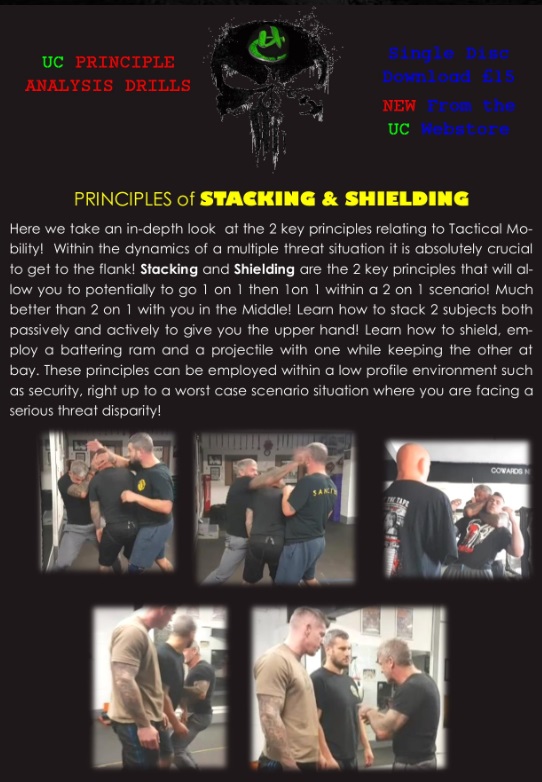
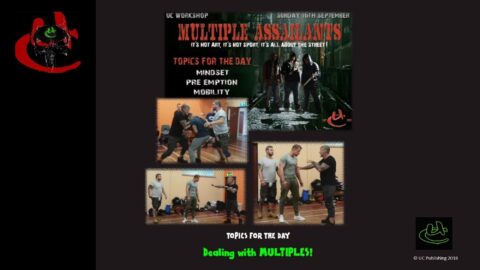
This 2 Disc Program takes an in-depth look at how we can train for dealing with a 2 on 1 Multiple Assailant Scenario with Safety but whilst Maintaining Dynamic, Non-Compliant Energy! Here we analyse all of the things that could Potentially go wrong if our initial Pre-emptive Action wasn’t Enough!
The 3 Key Principles that will allow you to Prevail in such are a Scenario; are MINDSET-Pre-Emption & Tactical Mobility. Here we will look at how to Employ the Principles of Stacking & Shielding, both essential when dealing with more than one Subject!
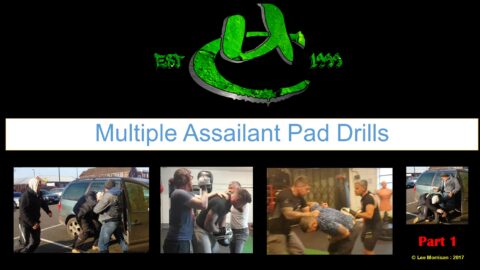
Look at these Pad drills, that integrate Partner to Pad cross-over, as a Bridge to Kitted Simulation Training. Static Pad drills inside of Combatives Training are a thing of the past! This kind of Training will take you into a NEW & Advanced method of Training.
All you need is Partners & Pads! Enjoy UC 2017
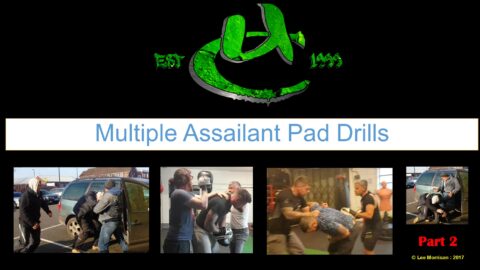
This 2 Disc Program takes an in-depth look at how we can train for dealing with a 2 on 1 Multiple Assailant Scenario with Safety but whilst Maintaining Dynamic, Non-Compliant Energy! Here we analyse all of the things that could Potentially go wrong if our initial Pre-emptive Action wasn’t Enough!
The 3 Key Principles that will allow you to Prevail in such are a Scenario; are MINDSET-Pre-Emption & Tactical Mobility. Here we will look at how to Employ the Principles of Stacking & Shielding, both essential when dealing with more than one Subject!
Look at these Pad drills, that integrate Partner to Pad cross-over, as a Bridge to Kitted Simulation Training. Static Pad drills inside of Combatives Training are a thing of the past! This kind of Training will take you into a NEW & Advanced method of Training.
All you need is Partners & Pads! Enjoy UC 2017
If we take a look into current UK statistics relating to knife crime, we can see that the equation is made up of multiple variables. Starting with youth or yob culture, it is clear that within the last 2 decades young people have become a lot more de-sensitised to violence in general, so much so that incidents of both knife carry as well as knife violence have been seen in youths from as young as 11 right through teenage years and beyond. In addition to this is the influx of multi-cultural society in the UK with people from all over the world, coming to the UK to live and work.
All of whom come with their own ideas and beliefs regarding what’s acceptable in terms of violence, which has been seen time and again, to include knife carry and usage as a cultural acceptance. Add to this, incidents of domestic and gratuitous knife violence often fuelled by alcohol, drugs and metal illness and you can see how a large percentage of reported violent offences in the UK have involved some kind of edged weapon. Such statistics have shown this to be the case to such a degree, that during any potentially violent confrontation we should expect a weapon and/or an accomplice.
Current UK laws are under review (with a view to imposing much harsher penalties for those caught carrying a knife) since the recent current boom of knife related tragedies such events have triggered frequent knife amnesties all over the UK, where knives and weapons of all kinds could be handed into any police station across the Country with no questions asked, in an attempt to get them off the streets. But the solid fact remains that its not knives and similar sharp items that are the problem. Any and all such things are simply tools, place even the most ferocious looking knife into a draw for a hundred years and it won’t hurt anyone. It is an individual’s INTENTION to harm another that turns that tool into a weapon and no amount of amnesties or random searches will take away INTENTION.
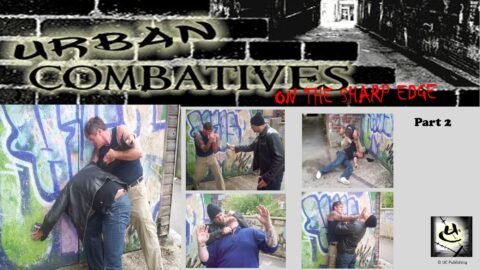
If intention is present then you could wreak havoc with a pencil, a piece of ripped tin or a shard of glass. “On the sharp edge’’ makes no bones about the fact that no one system of martial art or Combatives holds all the answers, in terms of a fail safe method of dealing with a knife unarmed! What it does offer is education and a heightened awareness to the problem.
In addition to this, it offers a logical physical response borne from live experience and the acid test of stress training. This programme is presented in a progressive and workable format and is intended for use in conjunction with and active training programme. You have no business attempting such physicality's lightly without tenacious practice, unless out of an act of sheer desperation!”
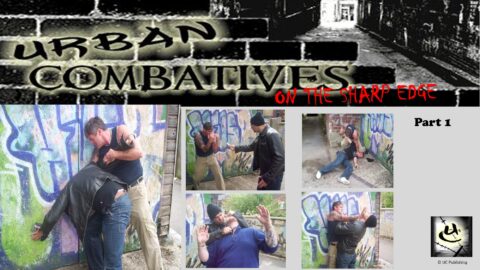
If we take a look into current UK statistics relating to knife crime, we can see that the equation is made up of multiple variables. Starting with youth or yob culture, it is clear that within the last 2 decades young people have become a lot more de-sensitised to violence in general, so much so that incidents of both knife carry as well as knife violence have been seen in youths from as young as 11 right through teenage years and beyond. In addition to this is the influx of multi-cultural society in the UK with people from all over the world, coming to the UK to live and work.
All of whom come with their own ideas and beliefs regarding what’s acceptable in terms of violence, which has been seen time and again, to include knife carry and usage as a cultural acceptance. Add to this, incidents of domestic and gratuitous knife violence often fuelled by alcohol, drugs and metal illness and you can see how a large percentage of reported violent offences in the UK have involved some kind of edged weapon. Such statistics have shown this to be the case to such a degree, that during any potentially violent confrontation we should expect a weapon and/or an accomplice.
Current UK laws are under review (with a view to imposing much harsher penalties for those caught carrying a knife) since the recent current boom of knife related tragedies such events have triggered frequent knife amnesties all over the UK, where knives and weapons of all kinds could be handed into any police station across the Country with no questions asked, in an attempt to get them off the streets. But the solid fact remains that its not knives and similar sharp items that are the problem. Any and all such things are simply tools, place even the most ferocious looking knife into a draw for a hundred years and it won’t hurt anyone. It is an individual’s INTENTION to harm another that turns that tool into a weapon and no amount of amnesties or random searches will take away INTENTION.
If intention is present then you could wreak havoc with a pencil, a piece of ripped tin or a shard of glass. “On the sharp edge’’ makes no bones about the fact that no one system of martial art or Combatives holds all the answers, in terms of a fail safe method of dealing with a knife unarmed! What it does offer is education and a heightened awareness to the problem.
In addition to this, it offers a logical physical response borne from live experience and the acid test of stress training. This programme is presented in a progressive and workable format and is intended for use in conjunction with and active training programme. You have no business attempting such physicality's lightly without tenacious practice, unless out of an act of sheer desperation!”
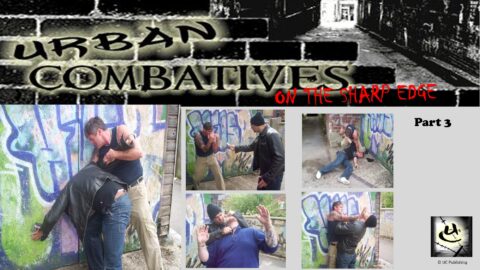
If we take a look into current UK statistics relating to knife crime, we can see that the equation is made up of multiple variables. Starting with youth or yob culture, it is clear that within the last 2 decades young people have become a lot more de-sensitised to violence in general, so much so that incidents of both knife carry as well as knife violence have been seen in youths from as young as 11 right through teenage years and beyond. In addition to this is the influx of multi-cultural society in the UK with people from all over the world, coming to the UK to live and work.
All of whom come with their own ideas and beliefs regarding what’s acceptable in terms of violence, which has been seen time and again, to include knife carry and usage as a cultural acceptance. Add to this, incidents of domestic and gratuitous knife violence often fuelled by alcohol, drugs and metal illness and you can see how a large percentage of reported violent offences in the UK have involved some kind of edged weapon. Such statistics have shown this to be the case to such a degree, that during any potentially violent confrontation we should expect a weapon and/or an accomplice.
Current UK laws are under review (with a view to imposing much harsher penalties for those caught carrying a knife) since the recent current boom of knife related tragedies such events have triggered frequent knife amnesties all over the UK, where knives and weapons of all kinds could be handed into any police station across the Country with no questions asked, in an attempt to get them off the streets. But the solid fact remains that its not knives and similar sharp items that are the problem. Any and all such things are simply tools, place even the most ferocious looking knife into a draw for a hundred years and it won’t hurt anyone. It is an individual’s INTENTION to harm another that turns that tool into a weapon and no amount of amnesties or random searches will take away INTENTION.
If intention is present then you could wreak havoc with a pencil, a piece of ripped tin or a shard of glass. “On the sharp edge’’ makes no bones about the fact that no one system of martial art or Combatives holds all the answers, in terms of a fail safe method of dealing with a knife unarmed! What it does offer is education and a heightened awareness to the problem.
In addition to this, it offers a logical physical response borne from live experience and the acid test of stress training. This programme is presented in a progressive and workable format and is intended for use in conjunction with and active training programme. You have no business attempting such physicality's lightly without tenacious practice, unless out of an act of sheer desperation!”
Related Videos

In this program we take our Combative Principles into a workable format on focus pads.
Knowing something or having a true understanding of how a principle works is only complete when you have a kinesthetic way to apply what you know. Here we employ such principles as; closest weapon/nearest target, high/low, cover-crash-counter, indexed-repeated strikes, flanking, branching, stop-hit, blitzkrieg and more with progressively applied pad training. Key points are given on feeding the pads, which is an art in itself as well as simple construction that will quickly take you into the realms of non-compliancy and spontaneity.
This program introduces UC Instructors Simon Grey and Tom Flint as well as 1st generation Instructor Jamie Miller.
This method of training with pads will totally accelerate your combative learning. Lots of key elements and fundamentals getting worked here; tool and impact development, bodyweight transference, understanding range, target-acquisition and transition , state access and management, perception speed, visual cue recognition and immediate spontaneous response.
Enjoy UC 2016

Due to the excellent feedback received from the previous three parts of this Combative Psychology series, I realised that there were still one or two areas that needed to be addressed in relation to the psychological aspects connected to aggressive and violent behaviour.
UC's foundation works from a basic core curriculum that focuses first and foremost on the two essential elements of Self Protection - namely: Personal Security or SOFT SKILLS, backed up with clinically efficient combative HARD SKILLS that take care of business in a physical sense if all else fails. This is the very foundation of UC - and indeed of any good reality-based method.
In addition to this, UC offers the student of Combatives two more follow-on programmes. One is COM-FIT, which focuses entirely on physical conditioning via cross-training to develop physical strength/fitness and attributes specific to combat. The second is PSY-COM, which relates specifically to mental conditioning and preparation so essential to TRUE combative functionality.
Without doubt, all fights begin and end in your head, and your personal pre-fight perspective is EVERYTHING! This programme is made up of an instructional lecture that comes directly from the PSY-COM programme. It deals specifically with cutting-edge ways of manipulating aggressive state in others, via non-physical options that are well proven for instantly reframing the classic "dick-head" perspective.
In addition to this, we follow on from part three with a previously unexplored part of the ARTIFICE module. Namely, cultivating the ability to pre-emptively strike from a natural and unobtrusive position with speed, impact, economy of motion and non-telegraphic intent - in order to either land the first strike that puts an end to the conflict, or in the worst-case scenario, a first strike that precedes an immediate, direct, explosive and continuous assault that won't stop until the threat subsides.


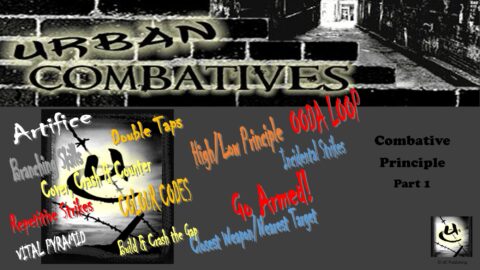
In this two-disc DVD project we take an in-depth look into the key Directives and Principles that drive any good Combative training curriculum or practiced method of Self-Protection and Personal Security.
Techniques and physical skill-sets are secondary to the mentality and concepts that drive them. We all know that any Conflict Resolution begin and end in your head, getting your head right pre-fight, in-fight & post-fight is absolutely essential. Combative perspective and attitude must be in place before the event.
From there if we must use force, then we want the most tactical application of physical force possible; hence our need for directives and principles. These boil down to two key psychological and physical attributes, “Impact with Attitude!”
These are the two key factors that should remain foundational to all forms of Combative efficiency, not this technique or that technique, or this piece of KIT or that piece of KIT; yes we need technical proficiency and yes KIT is useful but without MINDSET and Tactical Application the rest is ‘fluff!’ For the student of Combatives who is lucky enough to have the guidance of a good instructor, the most important priority lies in learning competent, conceptually driven skills, meaning just learn how to do it!
For learning and understanding beyond this point, as well as for instructors looking to install competence in their students; there is now a need to understand the actual how and why something actually works! The nuances of how something comes together to form a successful outcome. This project gives you UC‘s take on the said nuances, absorb and enjoy! LM 2010

In this two-disc DVD project we take an in-depth look into the key Directives and Principles that drive any good Combative training curriculum or practiced method of Self-Protection and Personal Security. Techniques and physical skill-sets are secondary to the mentality and concepts that drive them.
We all know that any Conflict Resolution begin and end in your head, getting your head right pre-fight, in-fight & post-fight is absolutely essential. Combative perspective and attitude must be in place before the event.
From there if we must use force, then we want the most tactical application of physical force possible; hence our need for directives and principles. These boil down to two key psychological and physical attributes, “Impact with Attitude!”
These are the two key factors that should remain foundational to all forms of Combative efficiency, not this technique or that technique, or this piece of KIT or that piece of KIT; yes we need technical proficiency and yes KIT is useful but without MINDSET and Tactical Application the rest is ‘fluff!’ For the student of Combatives who is lucky enough to have the guidance of a good instructor, the most important priority lies in learning competent, conceptually driven skills, meaning just learn how to do it!
For learning and understanding beyond this point, as well as for instructors looking to install competence in their students; there is now a need to understand the actual how and why something actually works! The nuances of how something comes together to form a successful outcome. This project gives you UC‘s take on the said nuances, absorb and enjoy! LM 2010