Counter Knife part 5
Introduction
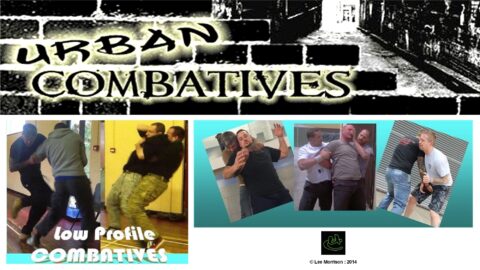
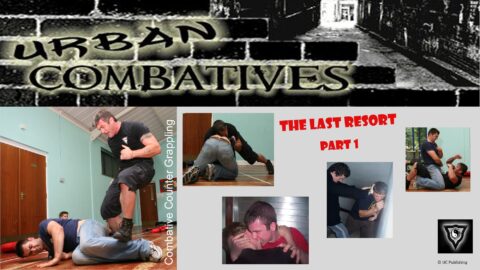
Grappling in any ‘’live’’ situation is really last resort stuff; the priority if avoidance and escape is not an option, is pre-emptive action via ballistic impact. If you have ended up on the ground then a mistake has been made and you will have to make the best out of a bad situation and quickly. The priority is to hurt your combative subject and get back to your feet as soon as you can.
Combative Counter Grappling
An Introduction to Counter Grappling (a last resort)
Secondary tools from ECQ
Restricted striking
Biting and gouging
Ballistic manipulations
Use of the environment
Counter grappling/vertical
Dealing with common grabs/holds
Countering Tackle
Counter grappling/horizontal
Passing the guard/street style
Attacking from the pins
Weapon access & deployment from ECQ
And Much More On This DVD
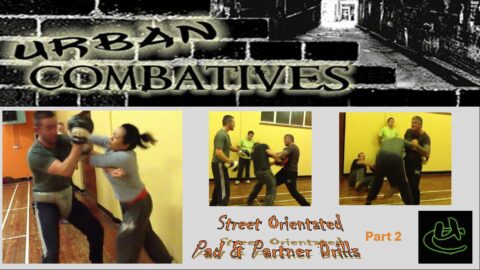
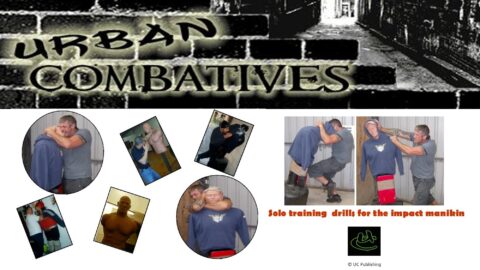
In The final part of our uc training drill series we look at how we can train for street orientated scenarios with the bare minimum of training kit.
All you need is a pair of pads, a partner, your training environment and your imagination to work everything from offensive, to counter offensive, to single and multiple assailants even if you have only one training partner.
This set shows you how to get the very best out of your training with the minimal of resources.
This 2 disc set offers 6 template drills that any good instructor or Combatives trainee could adapt and build upon.
If you were to add additional kit, protective equipment and additional environmental factors to the equation you really wouldn't need much more than that for great functional training.
These drills show you how to go from impactive strikes from close quarter's to partner manipulation at extreme close quarters, learning in-fight state management that will allow you to go from impactive kit to partner cross over safely.
Enjoy UC 2014
Related Videos
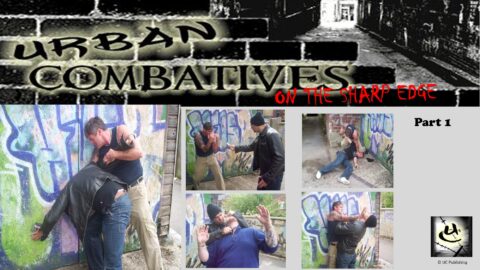
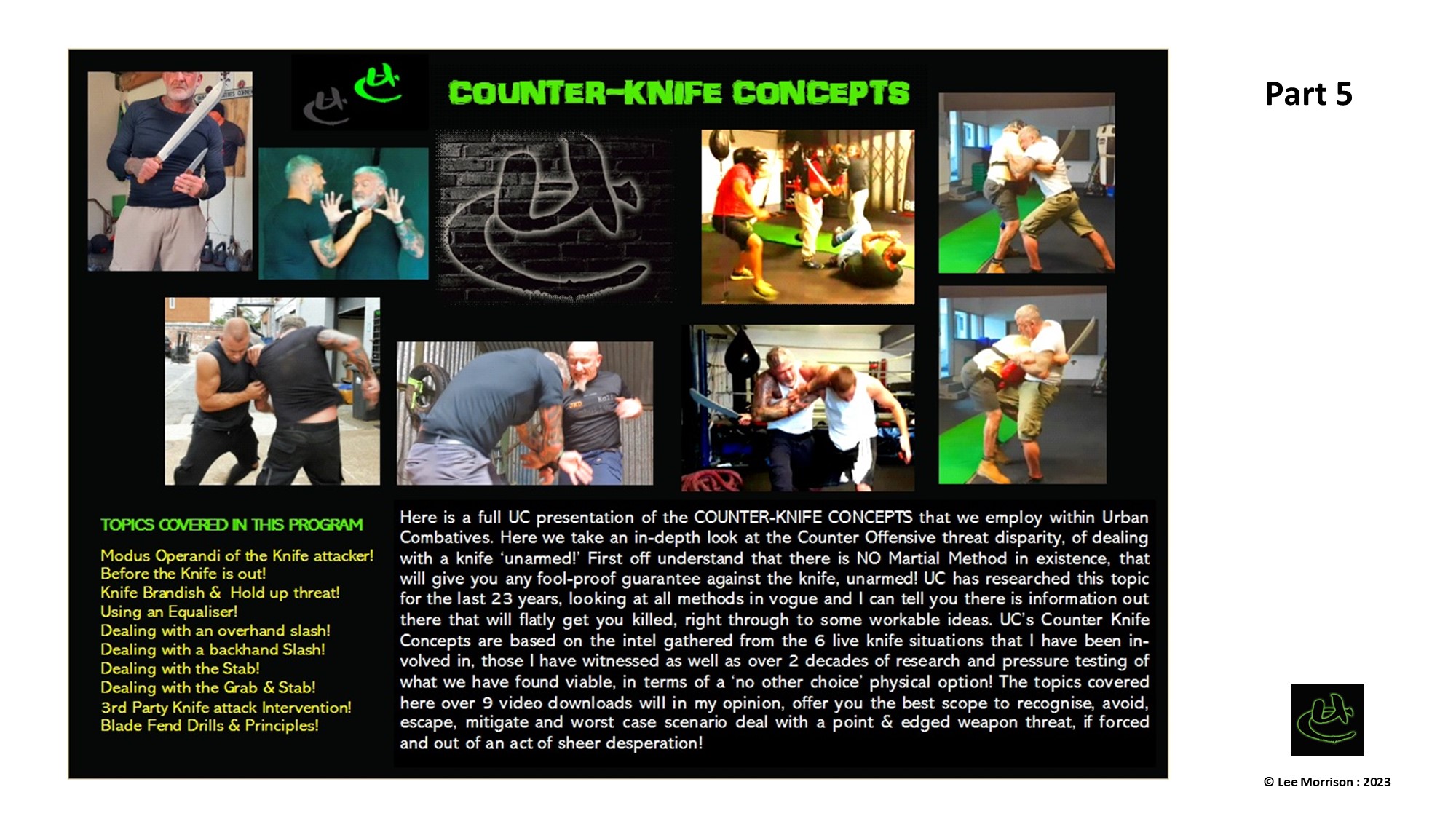
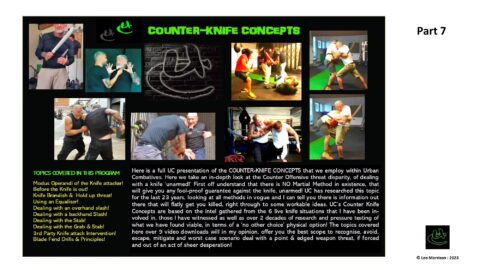
If we take a look into current UK statistics relating to knife crime, we can see that the equation is made up of multiple variables. Starting with youth or yob culture, it is clear that within the last 2 decades young people have become a lot more de-sensitised to violence in general, so much so that incidents of both knife carry as well as knife violence have been seen in youths from as young as 11 right through teenage years and beyond. In addition to this is the influx of multi-cultural society in the UK with people from all over the world, coming to the UK to live and work.
All of whom come with their own ideas and beliefs regarding what’s acceptable in terms of violence, which has been seen time and again, to include knife carry and usage as a cultural acceptance. Add to this, incidents of domestic and gratuitous knife violence often fuelled by alcohol, drugs and metal illness and you can see how a large percentage of reported violent offences in the UK have involved some kind of edged weapon. Such statistics have shown this to be the case to such a degree, that during any potentially violent confrontation we should expect a weapon and/or an accomplice.
Current UK laws are under review (with a view to imposing much harsher penalties for those caught carrying a knife) since the recent current boom of knife related tragedies such events have triggered frequent knife amnesties all over the UK, where knives and weapons of all kinds could be handed into any police station across the Country with no questions asked, in an attempt to get them off the streets. But the solid fact remains that its not knives and similar sharp items that are the problem. Any and all such things are simply tools, place even the most ferocious looking knife into a draw for a hundred years and it won’t hurt anyone. It is an individual’s INTENTION to harm another that turns that tool into a weapon and no amount of amnesties or random searches will take away INTENTION.
If intention is present then you could wreak havoc with a pencil, a piece of ripped tin or a shard of glass. “On the sharp edge’’ makes no bones about the fact that no one system of martial art or Combatives holds all the answers, in terms of a fail safe method of dealing with a knife unarmed! What it does offer is education and a heightened awareness to the problem.
In addition to this, it offers a logical physical response borne from live experience and the acid test of stress training. This programme is presented in a progressive and workable format and is intended for use in conjunction with and active training programme. You have no business attempting such physicality's lightly without tenacious practice, unless out of an act of sheer desperation!”
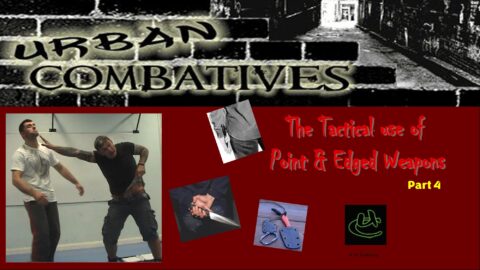
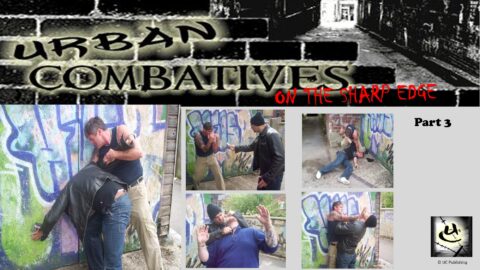
If we take a look into current UK statistics relating to knife crime, we can see that the equation is made up of multiple variables. Starting with youth or yob culture, it is clear that within the last 2 decades young people have become a lot more de-sensitised to violence in general, so much so that incidents of both knife carry as well as knife violence have been seen in youths from as young as 11 right through teenage years and beyond. In addition to this is the influx of multi-cultural society in the UK with people from all over the world, coming to the UK to live and work.
All of whom come with their own ideas and beliefs regarding what’s acceptable in terms of violence, which has been seen time and again, to include knife carry and usage as a cultural acceptance. Add to this, incidents of domestic and gratuitous knife violence often fuelled by alcohol, drugs and metal illness and you can see how a large percentage of reported violent offences in the UK have involved some kind of edged weapon. Such statistics have shown this to be the case to such a degree, that during any potentially violent confrontation we should expect a weapon and/or an accomplice.
Current UK laws are under review (with a view to imposing much harsher penalties for those caught carrying a knife) since the recent current boom of knife related tragedies such events have triggered frequent knife amnesties all over the UK, where knives and weapons of all kinds could be handed into any police station across the Country with no questions asked, in an attempt to get them off the streets. But the solid fact remains that its not knives and similar sharp items that are the problem. Any and all such things are simply tools, place even the most ferocious looking knife into a draw for a hundred years and it won’t hurt anyone. It is an individual’s INTENTION to harm another that turns that tool into a weapon and no amount of amnesties or random searches will take away INTENTION.
If intention is present then you could wreak havoc with a pencil, a piece of ripped tin or a shard of glass. “On the sharp edge’’ makes no bones about the fact that no one system of martial art or Combatives holds all the answers, in terms of a fail safe method of dealing with a knife unarmed! What it does offer is education and a heightened awareness to the problem.
In addition to this, it offers a logical physical response borne from live experience and the acid test of stress training. This programme is presented in a progressive and workable format and is intended for use in conjunction with and active training programme. You have no business attempting such physicality's lightly without tenacious practice, unless out of an act of sheer desperation!”
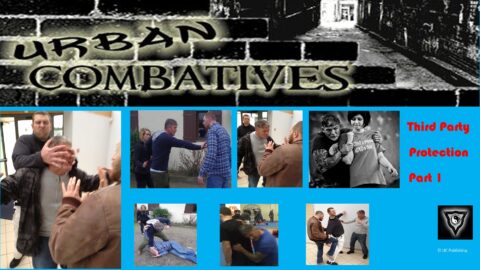
The mindset required for me to protect me is simple enough; this is the instinct of Self Preservation. But the mentality required for me to deal with an aggressive individual who actively seeks to hurt the person I’m with, particularly a significant other carries a very different potential consequence and therefore objective.
That objective lies in making sure that person doesn’t get hurt and gets away from the situation safely. The ideal would be to avoid or de-escalate the problem so we avoid the situation unharmed, but the reality is that life events are often less than ideal this is where some pre-planning for certain events can pay great dividends.
For example the significant people in my life know that if we are somewhere and get a problem with anyone they should ‘get behind me or ideally get away from me totally, either by running to a shop or similar place of safety or to get to the car, whatever, just get clear and let me deal with it!’ as opposed to get in the way or hold on to me in a way that might impair my movement and/or place us both in jeopardy.
Now at least regardless of the outcome to me, whether I take care of the problem quickly and clinically and escape relatively unscathed or worst case scenario even if I get hurt, the person I’m with is at least safe! Now the objective of Third Party Protection has been met! This is why the mentality is different; you are to a certain degree making a sacrifice so that person is protected.
The two key scenarios that relate to Third Party Protection are when you are actually with that person and a potential threat steps out in front of you or when you see someone that you are willing to protect getting verbally or physically assaulted by another person and now you have to encroach from a distance to actively intervene. this program addresses both of these aspects in detail.
This footage was filmed during two International Seminars, One in Dublin the other in Moscow and provides any Combatives trainee or Instructor alike with all of the key principles relating to this module...Enjoy UC 2012
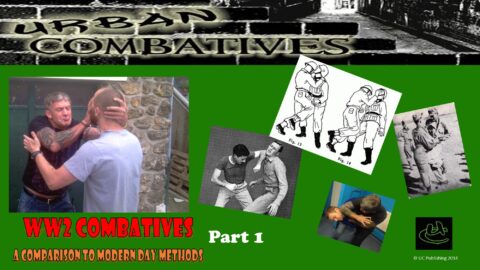
In this program we look at a comparison between the unarmed Combatives taught during the WW2 period compared to that of modern day Combative training.
Here We look at the kind of people that were learning for operational purposes and more importantly at some of the key figures that taught it during the war years.
For this we look to what was taught primarily in the UK and in the US. FROM THE British Commando /Auxiliary & s.o.e periods influenced by W.E. Fairbairn & E.A. Sykes.
To Dermot Pat O’Neil & John Jasper Styers of the US Army & US Marine Corp. WE also look AT THE Commonalties THAT Remain A CONSTANT TODAY FOR ANY WORTHY Combatives curriculum such as principle based methods, compressed curriculum and mentality driven emphasis.
Quite often the unarmed combat module of training constituted no more than 3 percent of the overall learning that some of these soldiers and operatives had to undertake, no more than a matter of hours, to learn something that could save your life or buy you time to get to a weapon before being sent to occupied territory where what you had learned ‘had to work’ or you wouldn't make it home!
This program is for historical study but also takes in to account the differing rules of engagement compared to today’s need for civilian self-protection and at what we have taken and continue to employ from the influence some of our close combat forefathers! enjoy UC 2014