Video
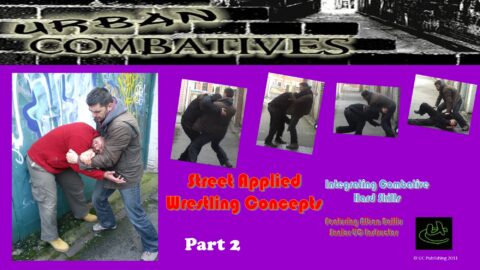
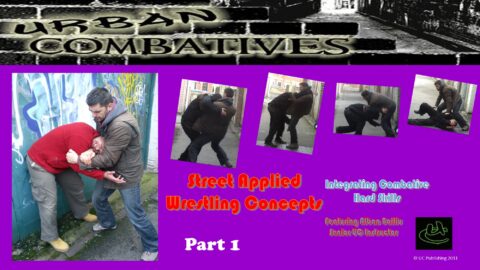
In this program we introduce UC’s most Senior Instructor outside of Lee Morrison, Alban Balliu; Alban has been with Lee since the very early days of UC and is from the First Generation of UC Instructors.
He has a vast background in Combatives training, having pretty much trained with anyone whose anyone worth talking about in this field. He has pressure tested with the best of them and accumulated his fair share of ‘live’ street experience over the years. Outside of that Alban is an accomplished strength athlete and competitive wrestler in both Free-Style and Greco Roman.
His knowledge of this subject is huge both as a competitor and from a conditioning aspect, Alban understands clearly that all means of grappling ‘in the street’ are strictly filed under secondary tools, IMPACT being the primary choice in the street if avoidance and escape are no longer an option.
With that said both Free Style and Greco contain nuggets of pure gold when Combatively integrated with gross motor IMPACT and explosive takedowns from a pavement perspective. As with all my top students I gave Alban my time and guidelines to functional Combative training as far as my knowledge would allow, then I told him to cross train and to seek ‘attributes’ from other methods without the clutter of accumulation.
His favoured direction was strength training and ‘real’ wrestling seeking out the people with real knowledge of the this great Close Quarter Staple, from some of the top Bulgarian coaches and competitors such as Boris Sabotinov to UK SDF legend Dave Turton.
This program is by no means an instead of strategy, more of an enlightenment to the fact that if the ‘ATTITUDE’ is right then additional concepts certainly have their place within the realms of Combative functionality! Enjoy... UC 2011
In this program we introduce UC’s most Senior Instructor outside of Lee Morrison, Alban Balliu; Alban has been with Lee since the very early days of UC and is from the First Generation of UC Instructors.
He has a vast background in Combatives training, having pretty much trained with anyone whose anyone worth talking about in this field. He has pressure tested with the best of them and accumulated his fair share of ‘live’ street experience over the years. Outside of that Alban is an accomplished strength athlete and competitive wrestler in both Free-Style and Greco Roman.
His knowledge of this subject is huge both as a competitor and from a conditioning aspect, Alban understands clearly that all means of grappling ‘in the street’ are strictly filed under secondary tools, IMPACT being the primary choice in the street if avoidance and escape are no longer an option.
With that said both Free Style and Greco contain nuggets of pure gold when Combatively integrated with gross motor IMPACT and explosive takedowns from a pavement perspective. As with all my top students I gave Alban my time and guidelines to functional Combative training as far as my knowledge would allow, then I told him to cross train and to seek ‘attributes’ from other methods without the clutter of accumulation.
His favoured direction was strength training and ‘real’ wrestling seeking out the people with real knowledge of the this great Close Quarter Staple, from some of the top Bulgarian coaches and competitors such as Boris Sabotinov to UK SDF legend Dave Turton.
This program is by no means an instead of strategy, more of an enlightenment to the fact that if the ‘ATTITUDE’ is right then additional concepts certainly have their place within the realms of Combative functionality! Enjoy... UC 2011
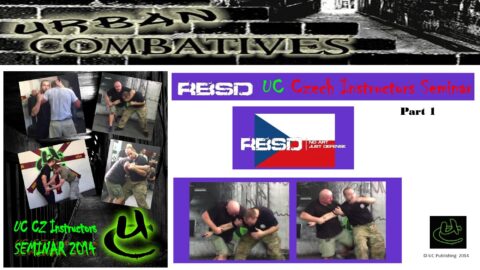
In this program we look at a comparison between the unarmed Combatives taught during the WW2 period compared to that of modern day Combative training.
Here We look at the kind of people that were learning for operational purposes and more importantly at some of the key figures that taught it during the war years.
For this we look to what was taught primarily in the UK and in the US. FROM THE British Commando /Auxiliary & s.o.e periods influenced by W.E. Fairbairn & E.A. Sykes.
To Dermot Pat O’Neil & John Jasper Styers of the US Army & US Marine Corp. WE also look AT THE Commonalties THAT Remain A CONSTANT TODAY FOR ANY WORTHY Combatives curriculum such as principle based methods, compressed curriculum and mentality driven emphasis.
Quite often the unarmed combat module of training constituted no more than 3 percent of the overall learning that some of these soldiers and operatives had to undertake, no more than a matter of hours, to learn something that could save your life or buy you time to get to a weapon before being sent to occupied territory where what you had learned ‘had to work’ or you wouldn't make it home!
This program is for historical study but also takes in to account the differing rules of engagement compared to today’s need for civilian self-protection and at what we have taken and continue to employ from the influence some of our close combat forefathers! enjoy UC 2014
In this program we look at a comparison between the unarmed Combatives taught during the WW2 period compared to that of modern day Combative training.
Here We look at the kind of people that were learning for operational purposes and more importantly at some of the key figures that taught it during the war years.
For this we look to what was taught primarily in the UK and in the US. FROM THE British Commando /Auxiliary & s.o.e periods influenced by W.E. Fairbairn & E.A. Sykes.
To Dermot Pat O’Neil & John Jasper Styers of the US Army & US Marine Corp. WE also look AT THE Commonalties THAT Remain A CONSTANT TODAY FOR ANY WORTHY Combatives curriculum such as principle based methods, compressed curriculum and mentality driven emphasis.
Quite often the unarmed combat module of training constituted no more than 3 percent of the overall learning that some of these soldiers and operatives had to undertake, no more than a matter of hours, to learn something that could save your life or buy you time to get to a weapon before being sent to occupied territory where what you had learned ‘had to work’ or you wouldn't make it home!
This program is for historical study but also takes in to account the differing rules of engagement compared to today’s need for civilian self-protection and at what we have taken and continue to employ from the influence some of our close combat forefathers! enjoy UC 2014
In this program we look at a comparison between the unarmed Combatives taught during the WW2 period compared to that of modern day Combative training.
Here We look at the kind of people that were learning for operational purposes and more importantly at some of the key figures that taught it during the war years.
For this we look to what was taught primarily in the UK and in the US. FROM THE British Commando /Auxiliary & s.o.e periods influenced by W.E. Fairbairn & E.A. Sykes.
To Dermot Pat O’Neil & John Jasper Styers of the US Army & US Marine Corp. WE also look AT THE Commonalties THAT Remain A CONSTANT TODAY FOR ANY WORTHY Combatives curriculum such as principle based methods, compressed curriculum and mentality driven emphasis.
Quite often the unarmed combat module of training constituted no more than 3 percent of the overall learning that some of these soldiers and operatives had to undertake, no more than a matter of hours, to learn something that could save your life or buy you time to get to a weapon before being sent to occupied territory where what you had learned ‘had to work’ or you wouldn't make it home!
This program is for historical study but also takes in to account the differing rules of engagement compared to today’s need for civilian self-protection and at what we have taken and continue to employ from the influence some of our close combat forefathers! enjoy UC 2014
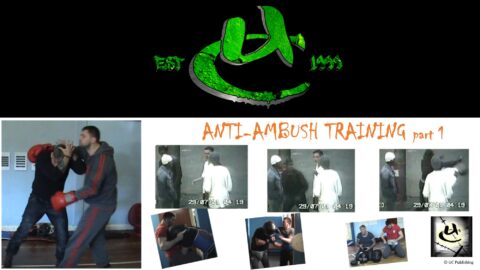
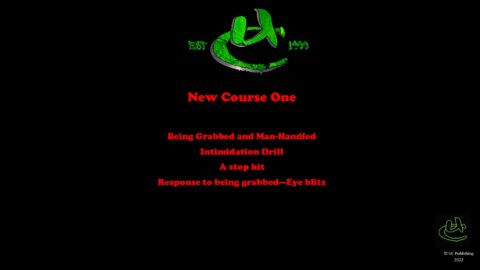
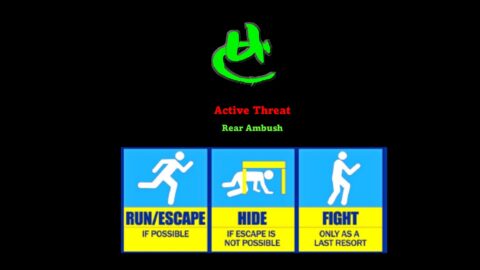
In this 2 part program we look into the Startle Reflex Response; applied to a variety of Counter Offensive Scenarios.
Most common attacks employed by a potentially hostile subject, regardless of motive will be simple and gross-motor in nature fuelled with Intent. The most favoured way in which such an assault would be used, would be via a pure unforgiving AMBUSH! Well here’s the news, if you get Ambushed without even the slightest inclination, then you've just been attacked.
What happens now depends how bad you've been hurt and how fast you can deal with it mentally. In short you will be stunned and shocked and unless you train for that dynamic; you will freeze up, leaving time and opportunity for the initiator to finish what he/she started, not good!
In the best World you’d have had your radar on, seen it coming and been proactive enough to avoid and escape, or at least control space and maybe take initiative first.
But what if you don’t? Well if you see absolutely nothing and get cold cocked then your getting knocked out. It doesn't matter about your skill level now, you got no chance to use it. BUT, if you do catch, even the slightest inclination literally half a second before or mid-attack then a simple principle based response of covering your head in a forwardly Offensive way can, has and will offer you momentary limitation from damage and a split second to explode with your Counter Offensive assault and bring the fight back to you.
But YOU MUST TRAIN IT TIL YOU GOT IT, THEN DRILL IT, TIL YOU OWN IT! Part one of Anti-Ambush Training offers you the Combatives trainee some workable drills to achieve that goal response.
The ideal would be to NEVER leave it this late, but if you did for whatever reason and the final pre-assault cue leaves you with a split second to react, be it something moving fast towards you're head caught out the corner of your eye, or a shadow across the ground, or the sudden tactile stimulus of getting grabbed or shoved just before the shot then this is a good place to start. View and enjoy with an open mind, get in your class and acid test what you take and build your Anti-Ambush response to a clear level of CONFIDENCE... Peace
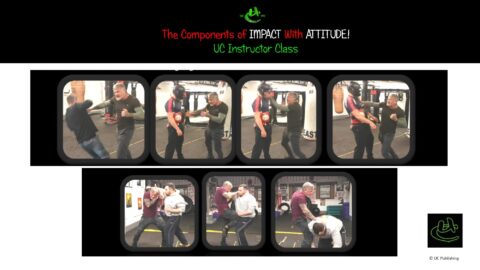
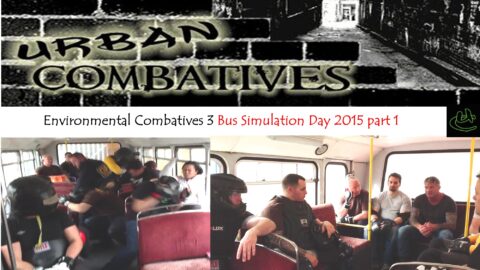
This 2 disc set depicts the best Instructional and Scenario scenes from our recent Environmental Scenario Training Day. This was the third of hopefully, five scenario days that we have planned, the next 2 being a train and a plane...
The two first were pub/bar environment then in-car scenario training and now the ‘bus’ commonality of all is confinement and restriction, going from close quarters to ECQ and back again.
Working from restriction requires a grasp of combative principles, the ability to branch skills and hit the mentality switch so necessary to the control of the emotional response associated with violence.
Here we got understanding and learning and a great pressure test of how well we know our tools! If you want to really know that what, you train so hard in, has merit and I mean REALLY? Then you’ve got to simulate! Period!
All of these works offer the Student/Instructor alike, with an example of how the scenario teaching template works. All Simulation Training requires competent design and supervision at all times, along with good KIT and a great bunch of people! This one had it all, Enjoy UC 2015….
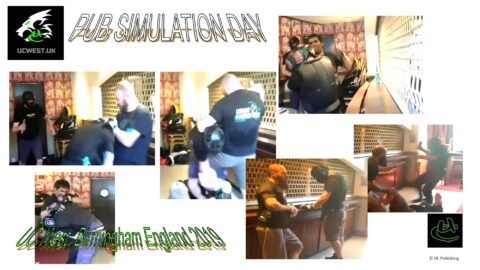
Here are some of the highlight lessons covered during the last UC West seminar in Birmingham, England 2019.
The topic for the day was Pub/Bar SIMULATION. We took an environmental look at some typical bar/pub fight scenarios along with recognition of some of the pre-threat behaviour, that will be present if you look!
After some savvy, we looked at the most useful Hard skills to employ, should escape, avoidance and verbal de-escalation remain totally unavailable!
Big thanks to Harj Sohal UC WEST and Dave Stevens of UC Midlands along with all the great people that turned up to Train.
Well Done! LM
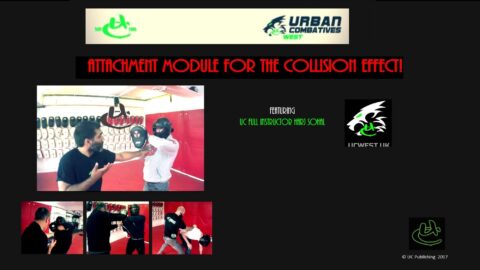

In this program we take our Combative Principles into a workable format on focus pads.
Knowing something or having a true understanding of how a principle works is only complete when you have a kinesthetic way to apply what you know. Here we employ such principles as; closest weapon/nearest target, high/low, cover-crash-counter, indexed-repeated strikes, flanking, branching, stop-hit, blitzkrieg and more with progressively applied pad training. Key points are given on feeding the pads, which is an art in itself as well as simple construction that will quickly take you into the realms of non-compliancy and spontaneity.
This program introduces UC Instructors Simon Grey and Tom Flint as well as 1st generation Instructor Jamie Miller.
This method of training with pads will totally accelerate your combative learning. Lots of key elements and fundamentals getting worked here; tool and impact development, bodyweight transference, understanding range, target-acquisition and transition , state access and management, perception speed, visual cue recognition and immediate spontaneous response.
Enjoy UC 2016
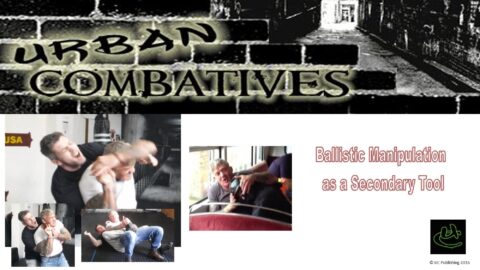
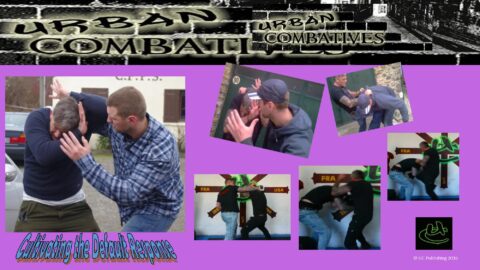
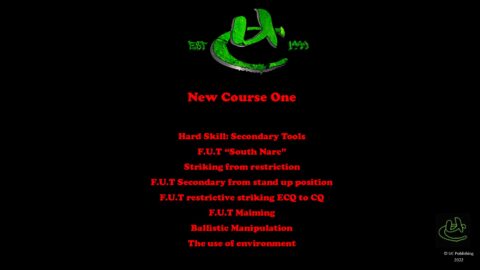
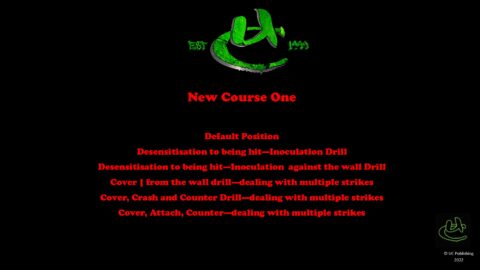
In this program we take an in depth look into the Default Cover position or ‘Startle Guard’ within the context of Counter Offence.
Here I give you progressive drills geared towards cultivating a Spontaneous Default Cover, based on very brief Intel in terms of Pre Threat Cues.
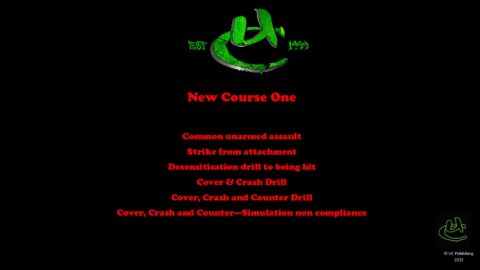
We move to a consistent progression into the Principle of Cover, Crash & Counter. The Default Cover is our primary non-diagnostic response to a variety of unarmed punching assaults that often come out of ambush or are simply caught late, offering the briefest of body language cues.
Further drills take us into the realms of Impact Inoculation. Employing graduated progressions, allowing you the chance to get comfortable with what most people feel uncomfortable with, ‘getting fucking Hit!’
This kind of training will take your confidence to a new level and allow you to focus effectively on dealing with an aggressive subject that got the jump on you!
You will learn that you CAN dominate quickly and clinically and put an end to the problem!
Enjoy UC 2016

A no nonsense approach to functional combatives and reality based Self-Protection for the Novice and Experienced trainee alike.
This DVD will provide you with the ability to functionalise the way you practise, what ever your art. This is the first in a series of instructional DVD’s by urban combatives for today’s environment
Testimonials
Geoff Thompson “Self Defence at it’s best”
Dave Turton “Leading figure for the future of self protection”
Kevin O’Hagen “A Charismatic Instructor”
Dennis Martin “Lee Morrison is a class act”
Marcus Wynne “Someone considered to be a huge & positive influence in this field”
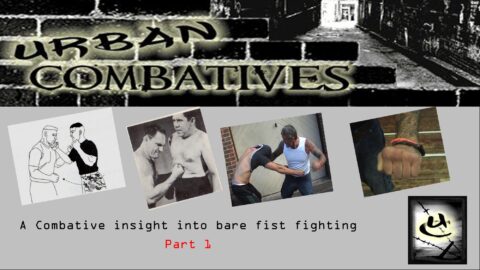
In this program we explore pugilism and the use of the bare-fist for combative dominance in the street. As practitioners of Combatives training; the closed fist is often frowned upon in favour of the open hand for striking, but the fact is; trained or untrained men punch and have always punched.
Even after many have made the transition to open hands, we will often default back to the addition of punching. Look at any account of street violence unarmed) and someone, somewhere is getting punched. We have fought this way for Centuries.
This DVD looks at some of the bare fist methods from the days of the old bare knuckle fighters, who employed closed fist blows in a huge variety of ways; to the Chinese pugilistic influence found within some of the early WW2 Close Combat programs.
We also look at figures who have influenced the pugilistic art of using the bare fist such as Daniel Mendoza, Robert Fitzsimmons, to Jack Dempsey and Jack Johnson; right up to some of the USMC and Marine Raiders influence as well as insights into how some of our Great Close Combat forefathers such as Drexel Biddle, John Styers and Charlie Nelson employed the bare fist as an addition to their compressed curriculum.
This program is full of Historical study as well as some workable and street adaptable ideas to employ within your Game Plan should you favour the use of the closed bare fist. We look into the pros and cons of Punching in terms of the need for specific targeting as well as using the correct areas of the fist for delivering impact whilst striving to minimise injury.
This program will leave you in no doubt to the clinical efficiency of a good puncher; even if you only take this knowledge on board for what to expect the next time you come across such a man! Enjoy UC 2012
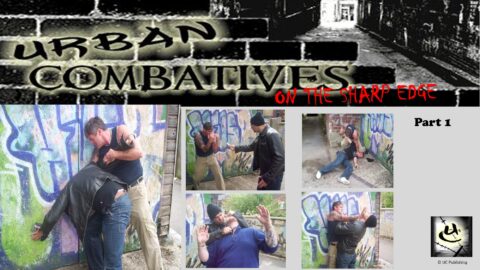
If we take a look into current UK statistics relating to knife crime, we can see that the equation is made up of multiple variables. Starting with youth or yob culture, it is clear that within the last 2 decades young people have become a lot more de-sensitised to violence in general, so much so that incidents of both knife carry as well as knife violence have been seen in youths from as young as 11 right through teenage years and beyond. In addition to this is the influx of multi-cultural society in the UK with people from all over the world, coming to the UK to live and work.
All of whom come with their own ideas and beliefs regarding what’s acceptable in terms of violence, which has been seen time and again, to include knife carry and usage as a cultural acceptance. Add to this, incidents of domestic and gratuitous knife violence often fuelled by alcohol, drugs and metal illness and you can see how a large percentage of reported violent offences in the UK have involved some kind of edged weapon. Such statistics have shown this to be the case to such a degree, that during any potentially violent confrontation we should expect a weapon and/or an accomplice.
Current UK laws are under review (with a view to imposing much harsher penalties for those caught carrying a knife) since the recent current boom of knife related tragedies such events have triggered frequent knife amnesties all over the UK, where knives and weapons of all kinds could be handed into any police station across the Country with no questions asked, in an attempt to get them off the streets. But the solid fact remains that its not knives and similar sharp items that are the problem. Any and all such things are simply tools, place even the most ferocious looking knife into a draw for a hundred years and it won’t hurt anyone. It is an individual’s INTENTION to harm another that turns that tool into a weapon and no amount of amnesties or random searches will take away INTENTION.
If intention is present then you could wreak havoc with a pencil, a piece of ripped tin or a shard of glass. “On the sharp edge’’ makes no bones about the fact that no one system of martial art or Combatives holds all the answers, in terms of a fail safe method of dealing with a knife unarmed! What it does offer is education and a heightened awareness to the problem.
In addition to this, it offers a logical physical response borne from live experience and the acid test of stress training. This programme is presented in a progressive and workable format and is intended for use in conjunction with and active training programme. You have no business attempting such physicality's lightly without tenacious practice, unless out of an act of sheer desperation!”